


Accounting Records Every UAE Business Must Keep: A Complete Compliance Guide
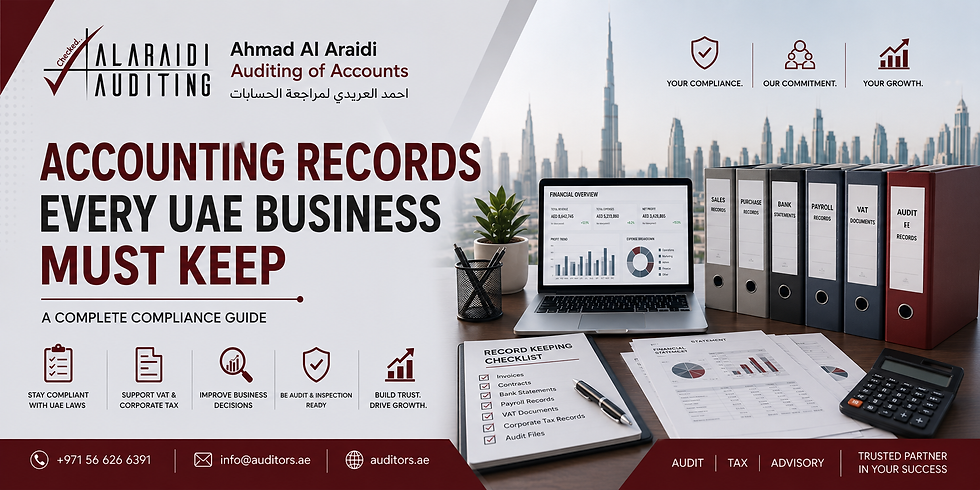
Accounting Records Every UAE Business Must Keep: A Complete Compliance Guide
Maintaining proper accounting records is one of the most important responsibilities of any business operating in the UAE. Whether you run a small startup, a trading company, a consultancy, a real estate brokerage, or a large corporation, accurate record keeping is essential for compliance, financial management, and business growth.
With the introduction of VAT, Corporate Tax, and increasing regulatory requirements, businesses are expected to maintain organized financial records that accurately reflect their operations. Failure to do so can result in penalties, audit challenges, tax disputes, and difficulties obtaining financing.
This complete compliance guide explains the accounting records every UAE business should maintain and why proper record keeping is crucial for long-term success.
Why Record Keeping Is Important
Many business owners only focus on accounting records when a tax return is due or an auditor requests documents. However, accounting records serve a much broader purpose.
Proper records help businesses:
Comply with UAE regulations
Support VAT and Corporate Tax filings
Monitor financial performance
Improve decision-making
Prepare for audits
Secure bank financing
Protect against disputes
Accurate records provide a clear picture of the financial health of a business and help management make informed decisions.
Legal Requirements for UAE Businesses
Under UAE regulations, businesses are generally required to maintain sufficient records that support their financial transactions and tax obligations.
These records may be requested by:
Federal Tax Authority (FTA)
External Auditors
Banks
Free Zone Authorities
Investors
Government Authorities
Businesses should ensure records are complete, accurate, and easily accessible.
Sales Records
Sales records form the foundation of business revenue reporting.
Businesses should maintain:
Tax Invoices
All VAT-compliant tax invoices issued to customers.
Simplified Tax Invoices
Where applicable under VAT regulations.
Credit Notes
Records of discounts, refunds, and sales adjustments.
Customer Statements
Outstanding balances and transaction history.
Sales Contracts
Agreements supporting revenue transactions.
Proper sales records help support revenue reporting and VAT compliance.
Purchase Records
Businesses should maintain complete records of all purchases and expenses.
These include:
Supplier Invoices
Invoices received from vendors and service providers.
Debit Notes and Credit Notes
Documents affecting supplier balances.
Purchase Orders
Internal approval and procurement records.
Expense Claims
Employee reimbursements and supporting documents.
These records are particularly important when recovering input VAT.
Bank Records
Bank transactions should always be supported by proper documentation.
Businesses should retain:
Bank Statements
For all business accounts.
Payment Confirmations
Evidence of transfers and settlements.
Deposit Records
Supporting customer receipts.
Loan Documents
Bank financing agreements and schedules.
Bank records help verify financial transactions and support audit procedures.
Payroll and Employee Records
Employee-related records are critical for compliance and financial reporting.
Businesses should maintain:
Employment contracts
Payroll registers
Salary transfer records
Leave records
End-of-service calculations
Employee reimbursement records
These documents support labor compliance and financial reporting obligations.
VAT Records
VAT-registered businesses have additional record-keeping responsibilities.
Important VAT documents include:
VAT Returns
Copies of submitted VAT returns.
VAT Payment Records
Proof of payments made to the FTA.
Import Documentation
Customs declarations and import records.
Tax Invoices
Supporting VAT calculations.
Maintaining organized VAT records reduces compliance risks and simplifies FTA reviews.
Corporate Tax Records
Corporate Tax compliance requires businesses to maintain detailed financial records.
Key records include:
Financial Statements
Profit and Loss Statement, Balance Sheet, and Cash Flow Statement.
General Ledger
Complete transaction history.
Trial Balance
Summary of account balances.
Tax Computations
Supporting calculations for taxable income.
Adjusting Entries
Documentation supporting tax adjustments.
These records are essential when preparing Corporate Tax returns.
Fixed Asset Register
Many businesses overlook the importance of maintaining an asset register.
The register should include:
Asset description
Purchase date
Purchase value
Depreciation details
Asset location
Disposal information
This information supports financial reporting and tax calculations.
Contracts and Legal Agreements
Businesses should retain copies of:
Customer contracts
Supplier agreements
Lease agreements
Loan agreements
Partnership agreements
Service agreements
Contracts provide evidence of business transactions and obligations.
Inventory Records
Companies dealing with physical products should maintain:
Stock Registers
Inventory movement records.
Purchase Records
Supplier documentation.
Sales Records
Inventory-related sales transactions.
Stock Count Reports
Periodic inventory verification records.
Accurate inventory records support financial reporting and profitability analysis.
Audit Records
Businesses that undergo external audits should maintain:
Prior year audit reports
Management letters
Audit adjustments
Supporting schedules
Reconciliation reports
These records assist future audits and improve financial transparency.
How Long Should Records Be Retained?
Businesses should maintain records for the periods required under applicable UAE laws and regulations.
Because requirements may differ depending on VAT, Corporate Tax, Free Zone regulations, and business activities, companies should adopt a long-term document retention policy and seek professional advice where necessary.
Digital storage systems can help ensure records remain secure and accessible.
Common Record-Keeping Mistakes
Many businesses face compliance issues due to poor record management.
Common mistakes include:
Missing Invoices
Lost documents can affect VAT recovery and audit support.
Delayed Bookkeeping
Waiting until year-end increases the risk of errors.
Mixing Personal and Business Expenses
This creates reporting and tax complications.
Lack of Supporting Documents
Transactions should always be supported by evidence.
Unreconciled Bank Accounts
Bank balances should regularly match accounting records.
Benefits of Proper Bookkeeping
Businesses with organized accounting records enjoy several advantages:
Better Decision-Making
Management has access to accurate financial information.
Easier Tax Compliance
VAT and Corporate Tax filings become simpler.
Faster Audits
Auditors can review records more efficiently.
Improved Cash Flow Management
Businesses can monitor collections and expenses effectively.
Increased Credibility
Banks, investors, and stakeholders prefer businesses with reliable financial records.
How Ahmad Al Araidi Auditing of Accounts Can Help
At Ahmad Al Araidi Auditing of Accounts, we assist businesses across the UAE with professional bookkeeping, accounting, VAT, Corporate Tax, and audit support services.
Our services include:
Bookkeeping and accounting
Financial statement preparation
VAT compliance
Corporate Tax compliance
External audit support
Management reporting
Financial review and advisory
We help businesses maintain accurate records while ensuring compliance with UAE regulations.
Conclusion
Proper record keeping is not just a legal requirement—it is a critical component of successful business management. Accurate accounting records support compliance, improve financial visibility, strengthen decision-making, and prepare businesses for audits and tax obligations.
As UAE regulations continue to evolve, businesses that invest in professional bookkeeping and document management will be better positioned for sustainable growth and long-term success.
Maintaining organized records today can save significant time, money, and risk tomorrow.
Frequently Asked Questions (FAQ)
Are accounting records mandatory in the UAE?
Yes. Businesses are generally required to maintain records supporting financial transactions and compliance obligations.
Why are accounting records important for Corporate Tax?
Corporate Tax calculations rely on accurate financial information and supporting documentation.
Can poor record keeping result in penalties?
Yes. Missing or incomplete records can create compliance issues and increase regulatory risks.
Is digital record keeping acceptable?
Electronic document management systems are commonly used to maintain and organize records.
Should small businesses maintain the same records as large companies?
While complexity may differ, all businesses should maintain adequate records supporting their operations.
